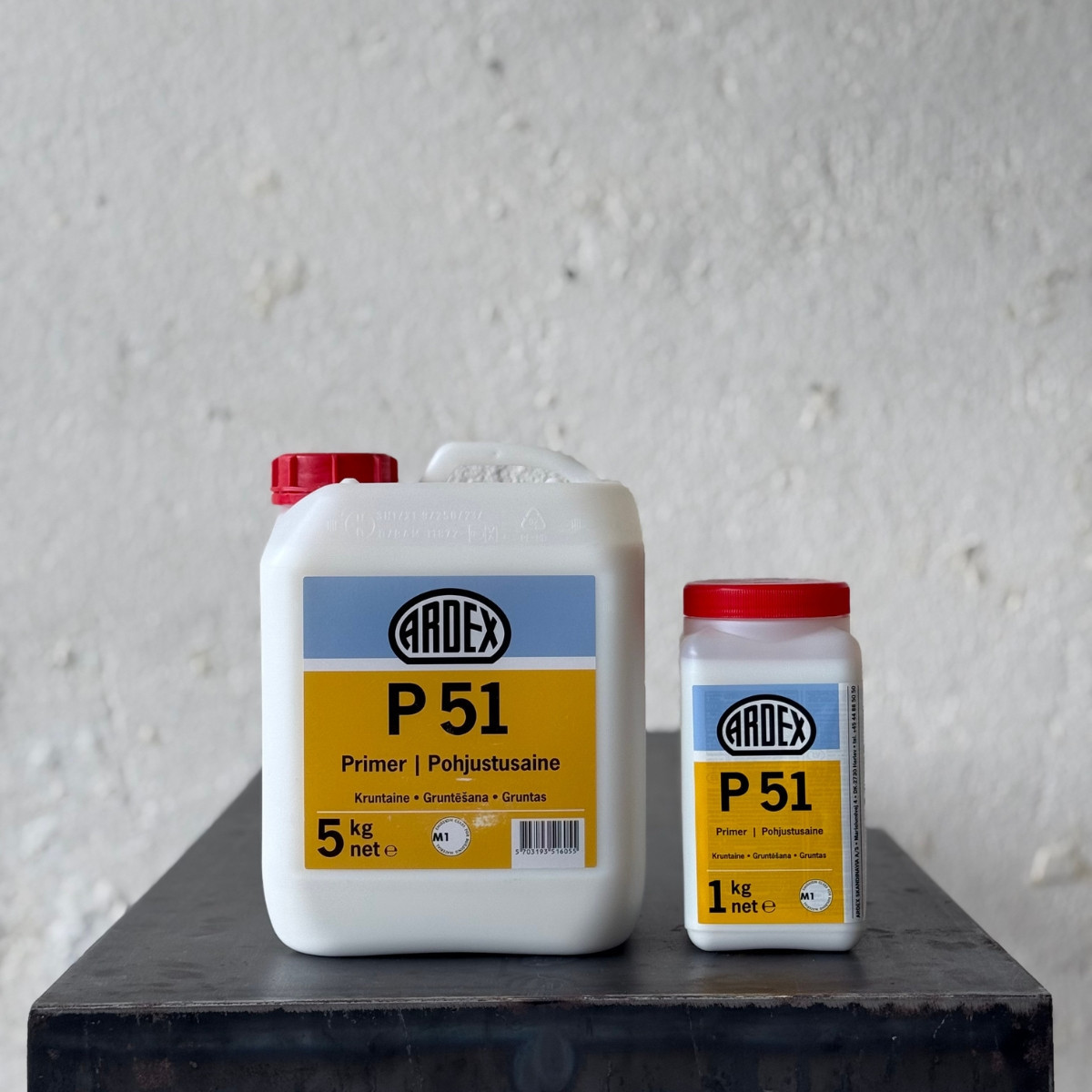
ARDEX P 51 deep primer
ARDEX P 51 is a primer designed for walls and ceilings. It is a reliable and versatile solution that ensures excellent adhesion, binds dust, seals pores, and repels moisture. It is ideal for priming absorbent surfaces before applying Mr. Clay clay plasters.
Coverage: when diluted with water at a 1:5 ratio, approx. 35–50 m².
Before applying clay plaster finishes, the primer is used mainly to slow down the drying process, but it is not always mandatory. Depending on the absorbency of the substrate, dilute the primer with water at a 1:4 or 1:5 ratio.
Before applying ClayBeton decorative finishes, it is crucial to dilute the primer precisely according to the substrate type, as this can affect the final decorative result:
Gypsum plaster: Prime with deep primer ARDEX P 51 (diluted with water 1:2) and additionally prime with a contact primer containing quartz sand.
Gypsum board panels: Prime with deep primer ARDEX P 51 (diluted with water 1:0.5) and additionally prime with a contact primer containing quartz sand.
ARDEX P 51 is a primer designed for walls and ceilings. It is a reliable and versatile solution that ensures excellent adhesion, binds dust, seals pores, and repels moisture. It is ideal for priming absorbent surfaces before applying Mr. Clay clay plasters.
Coverage: when diluted with water at a 1:5 ratio, approx. 35–50 m².
Before applying clay plaster finishes, the primer is used mainly to slow down the drying process, but it is not always mandatory. Depending on the absorbency of the substrate, dilute the primer with water at a 1:4 or 1:5 ratio.
Before applying ClayBeton decorative finishes, it is crucial to dilute the primer precisely according to the substrate type, as this can affect the final decorative result:
Gypsum plaster: Prime with deep primer ARDEX P 51 (diluted with water 1:2) and additionally prime with a contact primer containing quartz sand.
Gypsum board panels: Prime with deep primer ARDEX P 51 (diluted with water 1:0.5) and additionally prime with a contact primer containing quartz sand.

Safe purchase
.svg)
Home delivery

Refund
For indoor use – suitable for floors, walls, and ceilings.
Priming, improving adhesion, sealing pores, and repelling water.
Binding loose surface particles, e.g., on ground and highly absorbent calcium sulfate surfaces. Priming sand-cement screeds before applying levelling compounds or self-smoothing products.
Ensuring adhesion on dense concrete floors, calcium sulfate layers, terrazzo, sandstone, tiles, and panel surfaces before applying levelling compounds and thin-bed tile adhesives.
Ensuring adhesion on old substrates containing remnants of levelling compounds or adhesives.
Sealing pores on concrete floors and cement levelling layers:
• prevents air bubble formation,
• retains moisture in levelling compounds during curing.
Ensures adhesion on dense concrete before applying gypsum-based levelling compounds.
Priming gypsum, calcium sulfate, and wood-based boards before tile installation.
Provides a protective dust-binding layer on levelling compounds and self-smoothing screeds temporarily used as final surfaces.
Solvent-free white synthetic resin dispersion that, once dry, significantly reduces water penetration.
The substrate must be dry, firm, stable, and free of loose particles.
Shake the container before use. Pour ARDEX P 51 into a clean container and dilute with the required amount of water. Mix thoroughly. Apply evenly using a brush, roller, or broom. Subsequent work can be carried out after drying, once a thin, transparent film has formed.
When priming old substrates and ensuring strong adhesion while avoiding additional costs, verify that residues of old levelling compounds and adhesives are firmly bonded to the substrate, load-bearing, and not water-soluble.
Allow the primer to dry overnight and ensure it is completely dry before continuing.
Water-soluble or poorly adhering residues of old adhesives or levelling compounds (e.g., sulfide-based) must be completely removed. Residues of polyurethane, epoxy resin, or bitumen-based adhesives should be primed with ARDEX P 82 synthetic resin primer.
| Substrate / Application | Dilution Ratio |
|---|---|
| Smooth and dense substrates: precast concrete floors, highly compacted cement layers, calcium sulfate layers, terrazzo, stone, tiles, panel surfaces, or old substrates with adhesive/levelling residues, before levelling or tiling | 1 : 0.5 |
| Reinforced concrete floors, ceilings, columns | 1 : 1 |
| Porous, highly absorbent cement layers, and between levelling compounds/self-smoothing layers | 1 : 5 |
| Absorbent, sanded calcium sulfate layers | 1 : 3 |
| Smooth, compact concrete and reinforced concrete walls and ceilings before applying gypsum-based levelling compounds | 1 : 3 |
| Gypsum boards and gypsum plaster before wall levelling or tile fixing with thin-bed adhesives | 1 : 3 |
| Wood-based panels before levelling, smoothing, or bonding with ARDEX N 23 W / S 28 MICROTEC | Undiluted |
| Asphalt floors with low sand content, old asphalt floors, magnesite floors, synthetic surfaces, metal, wood, lacquered surfaces before applying levelling compounds or tile adhesives | – |
| Concrete floors or sand-cement screeds outdoors and in damp environments before applying ARDEX K 301 or between ARDEX K 301 layers | 1 : 7 |

